
BOP Federal Release Scope
The Bureau of Prisons locator applies to people committed to federal prison. It is not a universal federal detainee search. The U.S. Marshals Service commonly holds federal pretrial and court detainees in contracted local facilities, and no general public USMS locator was verified. A person arrested in a federal case can therefore be in federal process without appearing as a sentenced BOP inmate.
No dedicated federal prison was verified in Tyrrell County. This system page is a conditional branch. Use it when a federal judgment, jail destination entry, or other official record points to a federal sentence. For a Tyrrell local arrest housed at Dare, begin with Dare and the Tyrrell court unless the record identifies a federal receiving agency.
| Situation | Best first source |
|---|---|
| Sentenced federal prisoner | BOP Inmate Locator |
| Federal pretrial detainee | Federal court, responsible USMS district, holding facility |
| Tyrrell local booking | Dare release record and Tyrrell court |
| Immigration transfer | ICE locator and ERO, not BOP |
Search BOP Release Records
Open the official BOP Inmate Locator. It covers federal inmate records from 1982 forward. Search by BOP Register Number, DCDC number, FBI number, or INS number when available. A number is the strongest discriminator. The name search offers age, sex, and race filters, which should be used only to distinguish a known person.
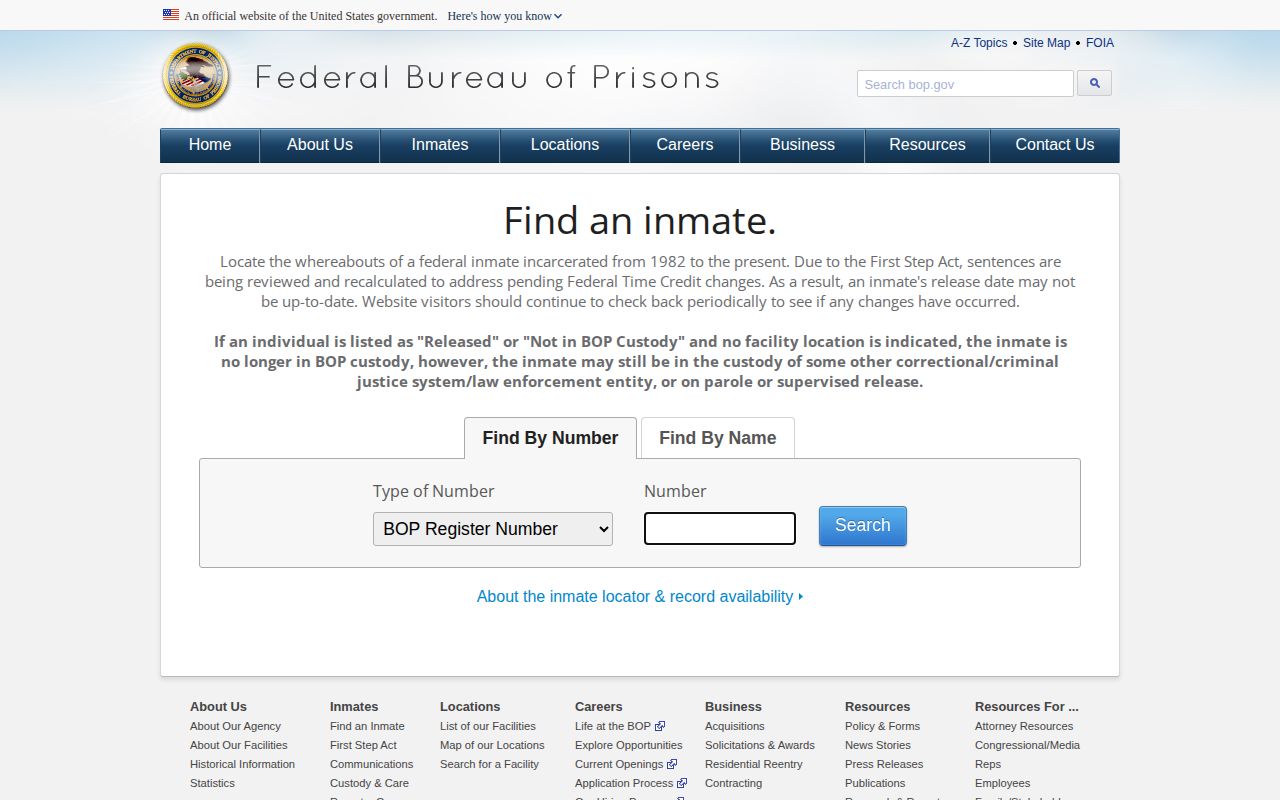
The official form makes the federal scope visible. It does not search Dare bookings, NCDAC prison terms, or ICE detention. Follow these steps after the custody system has been classified.
- Search an exact federal identifier first. If none is known, enter the name and narrow cautiously.
- Compare the register number, name, age, sex, and race before treating the result as the correct person.
- Read the location and release field exactly as displayed. Save the identifier and access date.
- Distinguish a past release date from a future projected date, “Unknown,” and “In transit.”
- Check the federal docket or clerk record for the judgment and any later supervision.
- If there is no BOP result, investigate USMS pretrial custody rather than declaring release.
Read BOP Release Labels
BOP labels must be reported conservatively. “Released” means the person is no longer in BOP custody. A displayed past date with no institution means the person left BOP custody on that date. It does not rule out supervised release or custody by another agency. “Unknown” means the term or date is undetermined. “In transit” is movement within custody, not release.
A future date is projected. Recalculation can change it. Community Corrections Management or a residential reentry placement also has a distinct custody context and should not be summarized as an unconditional discharge. The BOP locator record explanation supplies the agency's status and date guidance.
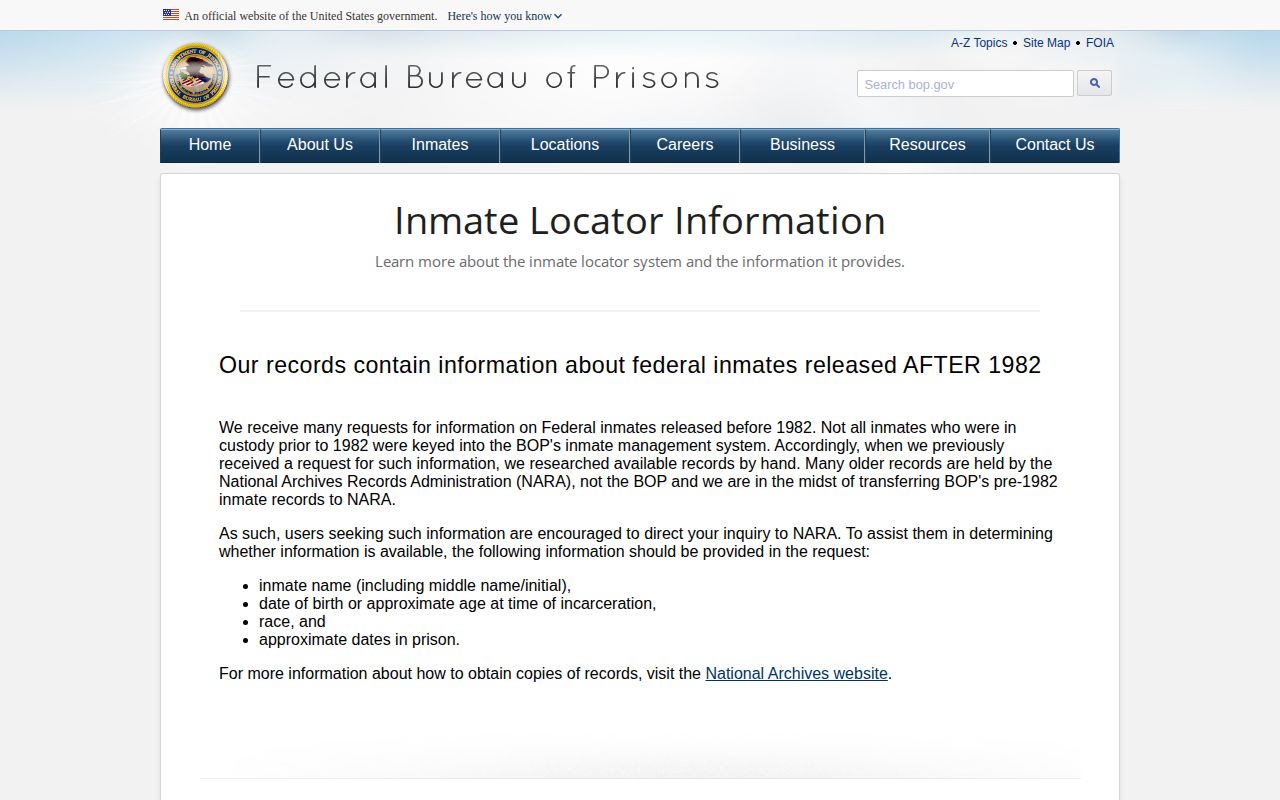
The status explanation supports precise wording such as “released from BOP custody.” It does not support the broader claim that the person is free from every custodian.
BOP Historical Release Records
The locator's public coverage begins in 1982. BOP directs questions about older federal inmate records to the National Archives. For a record within the locator period, note the register number, release label, date, and whether a facility is displayed. Pair those fields with the federal judgment when the legal sentence or supervision terms matter.
When the locator lacks enough detail, use the BOP locator first and then the appropriate federal records process. A focused request identifies the person, register number, incarceration period, and public release fields. It should not ask BOP to supply a Tyrrell jail booking or a USMS pretrial movement it does not own.
- Released
- No longer in BOP custody as of the date shown.
- Projected date
- A future estimate that may change.
- In transit
- Movement within a custody chain, not community release.
- Supervised release
- Court-ordered federal supervision after imprisonment, separate from BOP custody.
USMS Versus BOP Release
A BOP no-result has limited meaning. USMS may hold a person awaiting trial, sentencing, transport, or a court appearance at a contract facility. Confirm the case through PACER or the federal clerk, then contact the responsible USMS district or named holding facility for the custody event. The federal docket can explain detention orders and sentence terms but may not show the exact door-release time.
If Dare's release record says the person went to USMS, describe that event as a transfer from local custody. Search BOP only if the later federal record supports a prison commitment. A federal arrest alone is not enough. This distinction prevents a local jail departure from being mislabeled as community release.
Note: The absence of a public USMS locator makes the court and named holding facility essential fallback channels.
Tyrrell Federal Release Chain
Tyrrell's normal local path remains split between Dare Detention and the Tyrrell court. Federal tools enter only when evidence points there. The Tyrrell County release-record path begins with the booking facility, then follows the receiving agency named in the record. This order matters because local, state, federal criminal, and immigration systems do not share one complete public roster.
A defensible chain might read: Dare reports transfer to USMS on a specific date; the federal docket confirms the criminal case; BOP later records admission and release from a federal sentence. Each source proves one segment. If the sequence stops at a local-to-USMS transfer, do not invent a BOP sentence or final release.
Two Tyrrell Custody Systems
Tyrrell County's distinctive facility issue is the contrast between a large state prison within the county and local detainees housed in Dare. Neither fact creates federal custody. Tyrrell Prison Work Farm belongs to NCDAC. Dare is the evidence-supported local housing jail. BOP is a third, conditional system tied to a federal sentence.
Classifying the system first saves time and prevents false conclusions. Use NCDAC for the work farm, Dare for local jail releases, and BOP for sentenced federal prisoners. A transfer record is the bridge between systems. Without that bridge or a federal judgment, BOP should not be the default Tyrrell lookup.
Note: No dedicated BOP institution in Tyrrell County was established by the official-source sweep.
Preserve Federal Release Evidence
Save the register number, exact BOP status, release date or projected label, displayed location, URL, and access date. Pair those facts with the matching federal case rather than a same-name assumption. If the person moved through a local contract jail, keep the local departure record as a separate custody episode. Each source should be asked only about the event it created.
For a federal sentence, the judgment supplies the term and any supervised-release provision. The BOP locator supplies the public prison status and date. A federal docket event may precede BOP processing, just as a local transfer can precede admission to the next system. Keep the dates in sequence and do not treat normal processing lag as proof that one agency's record is false.
Records before 1982 require a different historical route because BOP points older material to the National Archives. For newer records, begin with the locator and use the register number in any follow-up. Ask for the existing release fields rather than a new account of every federal interaction. This keeps the request within BOP's sentenced-prison scope.
A careful conclusion says “released from BOP custody” and gives the recorded date. If supervised release follows, state that separately from prison custody. If the locator shows no match and the court indicates pretrial detention, the responsible USMS district and named facility remain the proper route. These narrow statements are more useful than a broad claim that cannot be supported across all custodians.